
Same Failed Strategy, Different Target: From War on Drugs to War on Immigration
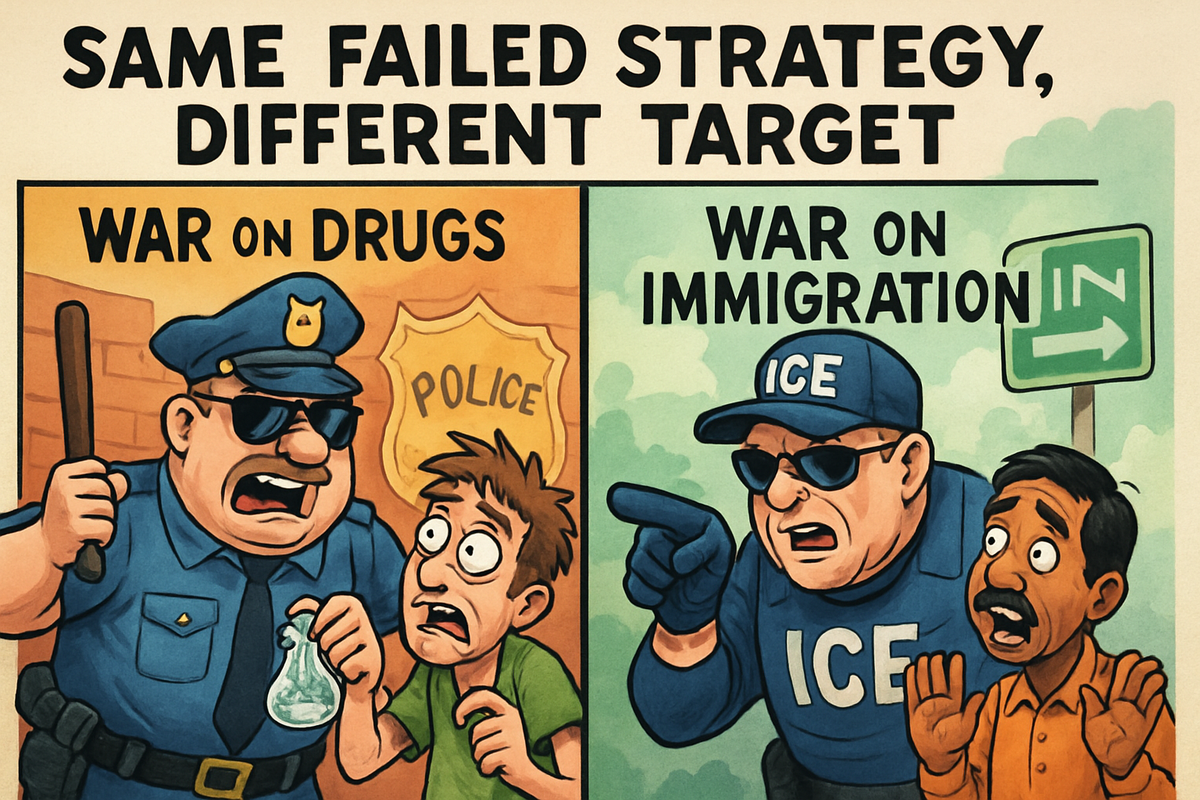
How America is repeating the costly mistakes of the War on Drugs with immigration enforcement
For over fifty years, America has waged a "War on Drugs" that has cost taxpayers hundreds of billions of dollars while accomplishing virtually none of its stated goals. Despite dramatic increases in incarceration for drug offenses, substance misuse rates remained unchanged, crime rates declined for reasons unrelated to mass imprisonment, and communities were devastated by the removal of millions of people. Now, as we pivot toward an equally costly and misguided "war on immigration," it's worth examining how we're about to repeat the same expensive mistakes with similarly predictable results.
The Numbers Don't Lie: A Massive Budget Shift
The Department of Homeland Security's budget for fiscal 2026 proposes $107.4 billion, an increase of $42.3 billion, or 64.9 percent, above the $65.1 billion fiscal 2025 enacted level. For context, the FBI's FY 2025 budget request is $11.3 billion - nearly ten times smaller than DHS's massive allocation.
This represents one of the largest peacetime budget increases for a single agency in recent memory, all in service of what officials call "mass removal campaigns" and border wall construction. Meanwhile, the same administration that claims fiscal responsibility is about to spend more on deportations than the entire annual budget of most federal agencies.
The War on Drugs Playbook: Costly, Counterproductive, Discriminatory
The parallels between the War on Drugs and current immigration enforcement are striking:
Target the Small Players, Ignore the Big Picture
Every 25 seconds, someone in America was arrested for drug possession, with 1.3 million arrests per year in 2015—six times the number of arrests for drug sales. The focus was overwhelmingly on users and low-level dealers while the major trafficking organizations adapted and thrived.
Similarly, immigration enforcement focuses primarily on immigrants working in kitchens, farms, and construction sites rather than the employers who actively recruit and exploit undocumented labor. ICE raids target the vulnerable workers, not the executives who profit from their desperation.
Massive Incarceration with Minimal Results
The United States increased its prison population from 360,000 in the early 1970s to nearly two million people today, with much of this growth driven by drug offenses. Yet research consistently shows that higher imprisonment rates for drug offenses have no correlation with reduced drug problems in communities.
The immigration enforcement version promises to be equally expensive and ineffective. The proposed funding would enable DHS "to fully implement the President's mass removal campaign," including billions for detention beds and deportation operations.
Devastating Racial and Social Impact
Black Americans are four times more likely to be arrested for marijuana charges than their white peers, despite equal usage rates, and make up nearly 30 percent of all drug-related arrests despite being only 12.5 percent of substance users. The War on Drugs was explicitly designed as a racially motivated crusade, according to Nixon advisor John Ehrlichman.
Immigration enforcement follows similar patterns, disproportionately targeting Latino communities and mixed-status families, regardless of individual circumstances or community ties.
The Real Culprits: Following the Money
While America spent decades imprisoning drug users, the real architects of the opioid crisis were making billions in plain sight. The Sackler family and Purdue Pharma recently agreed to a $7.4 billion settlement for their role in creating the opioid epidemic through aggressive marketing of addictive painkillers. As of 2024, the family's collective net worth was estimated at $10.8 billion, built largely on addiction and death.
The Sacklers weren't arrested in midnight raids. They weren't separated from their families or held in detention centers. They attended board meetings, donated to museums, and lived in mansions while their products contributed to over 100,000 overdose deaths annually.
This is the pattern we see repeated: blame Mexico for fentanyl while American pharmaceutical executives got rich creating the demand; blame China for precursor chemicals while American companies failed to report suspicious orders; blame Canada for being a drug transit route while the real money flows through American financial institutions.
What Actually Works: Evidence-Based Solutions
The research on effective approaches is clear:
Drug Policy: Drug courts that focus on treatment rather than incarceration reduce recidivism by 26 percent and show lasting benefits, with participants 24 percent less likely to be rearrested for drug offenses even 14 years later.
Immigration: Comprehensive immigration reform that provides pathways to legal status reduces exploitation, increases tax compliance, and allows law enforcement to focus on actual security threats rather than economic migrants.
Border Security: Addressing root causes of migration through economic development and anti-corruption efforts in origin countries has proven far more effective than walls and detention centers.
The Price of Repetition
Over five million people are currently under criminal justice supervision, with incarceration costs that cannot be justified by any evidence of effectiveness. The War on Drugs created entire industries built around imprisonment while failing to address the underlying issues driving substance abuse.
The war on immigration threatens to do the same thing on an even larger scale. Private detention companies are already expanding facilities in anticipation of increased enforcement. Border communities are being militarized. Families are being torn apart.
Meanwhile, the structural issues that drive migration—climate change, economic inequality, violence, and corruption—remain unaddressed. The employers who create the demand for undocumented labor face minimal consequences. The complex global forces driving population movements are reduced to simplistic enforcement solutions.
A Different Path Forward
Real solutions require acknowledging complex realities:
Address Labor Demand: Serious sanctions for employers who exploit undocumented workers, combined with expanded legal immigration pathways that meet actual economic needs.
Focus on Genuine Threats: Immigration enforcement should prioritize individuals who pose actual security risks, not families seeking opportunity.
Evidence-Based Drug Policy: Treat addiction as a public health issue with proven interventions like medication-assisted treatment, harm reduction, and community-based support.
Corporate Accountability: When American companies profit from exploitation—whether of addicted patients or vulnerable workers—they should face consequences proportional to their role in creating the problem.
The Bottom Line
America is about to spend over $100 billion annually on immigration enforcement using the same failed strategies that characterized the War on Drugs. We'll arrest the vulnerable while ignoring the powerful. We'll break up families while corporations continue profiting from exploitation. We'll militarize our communities while the root causes of migration persist.
After decades of mass incarceration, crime rates are at historic lows—not because of imprisonment, but despite it. The most punitive approach proved to be the least effective.
The definition of insanity is doing the same thing repeatedly while expecting different results. America spent fifty years and hundreds of billions of dollars learning that you can't arrest your way out of complex social problems.
It's time to apply those lessons before we waste another fifty years and another half-trillion dollars repeating the same mistakes with immigration. The only question is whether we're wise enough to learn from our own history or doomed to repeat it at an even greater cost.