
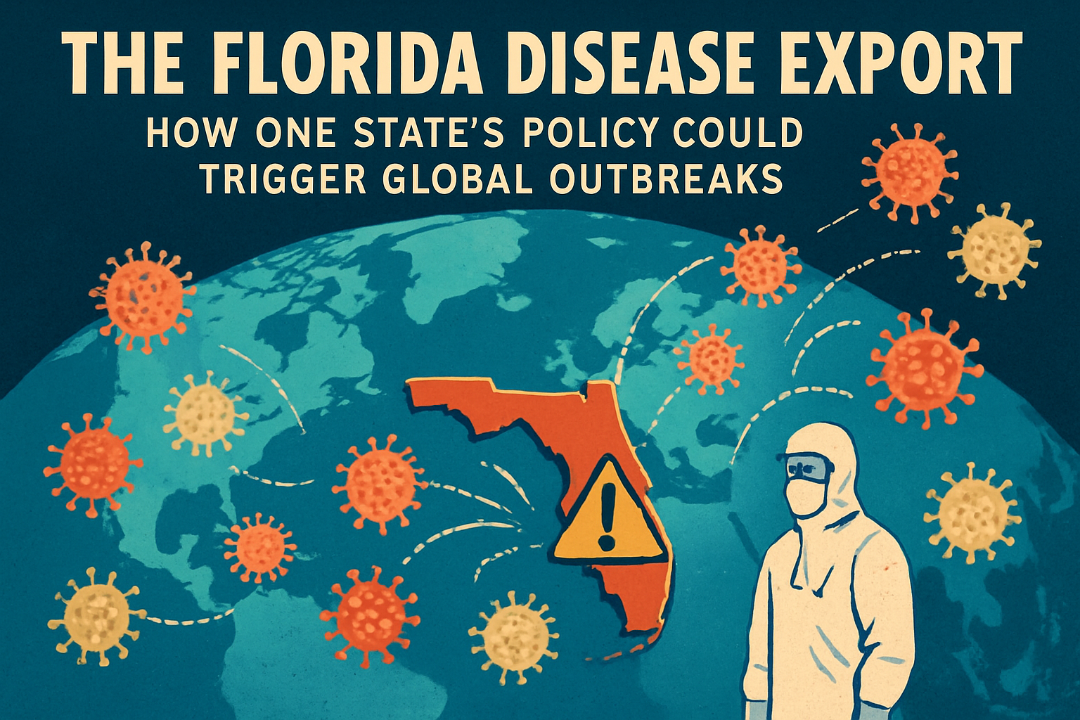
Part 2: The Florida Disease Export - How One State's Policy Could Trigger Global Outbreaks
Published: [Date9/17/2025]
Florida's decision to eliminate all vaccine mandates doesn't just affect Floridians—it could create a global public health crisis. With millions of international visitors flocking to Disney World, Universal Studios, and Florida's beaches each year, the state is uniquely positioned to become a disease transmission hub that could export preventable illnesses worldwide.
The Perfect Storm Brewing
Picture this scenario, which public health experts are likely already modeling:
A family in Tampa decides not to vaccinate their children, citing the new policy. Their 4-year-old develops measles but isn't showing symptoms yet (measles has a 10-14 day incubation period). The family takes a trip to Disney World, where the child rides attractions, eats at restaurants, and mingles with thousands of visitors from around the globe.
Among those visitors: a 6-month-old infant from Germany, too young to be vaccinated. The baby's parents have no idea their child has been exposed. They board a plane back to Frankfurt, where the infant develops symptoms days later. By then, the baby has exposed dozens of people on the plane, in airports, and back home in Germany.
This isn't science fiction—it's a predictable consequence of Florida's policy decision.
The Numbers Are Staggering
Consider the scale of potential transmission:
- Disney World alone: 58 million visitors annually
- Orlando International Airport: One of the world's busiest airports
- Universal Studios: 20+ million visitors per year
- Florida beaches: Hundreds of millions of visitor-days annually
A single infected child at Magic Kingdom could potentially expose thousands of people from dozens of countries in one day. Florida's theme parks and attractions act as massive mixing bowls where people from every corner of the globe converge in concentrated spaces.
Real-World Precedent
This scenario isn't hypothetical. We've already seen similar patterns:
- The 2014-2015 Disneyland measles outbreak infected 147 people across multiple states and countries
- International travel has repeatedly reintroduced eliminated diseases to countries with high vaccination rates
- Measles outbreaks in Europe and other regions have been traced back to travelers from areas with low vaccination coverage
But those were isolated incidents. What Florida has created is the potential for systematic, ongoing disease transmission on a global scale.
International Implications
Countries that have worked for decades to eliminate diseases like measles could see widespread reintroduction from Florida tourism. The diplomatic and legal complications would be enormous:
- Could countries sue Florida or the U.S. for damages from disease outbreaks traced to Florida tourism?
- Might nations impose travel restrictions or quarantine requirements for visitors from Florida?
- How would international health organizations respond to a deliberate policy that increases global disease transmission risk?
Economic Boomerang Effect
The irony of Florida's "freedom" policy is that it could severely restrict the state's economy and residents' freedoms:
Tourism Industry at Risk: If Florida becomes known as a disease transmission hub, tourism could plummet. Travel advisories, vaccination requirements for visitors, or international boycotts could devastate the state's economy.
Business Liability: Theme parks, hotels, restaurants, and other businesses could face massive lawsuits from visitors who contract diseases in Florida. Imagine Disney facing wrongful death suits from families whose infants died after exposure at their parks.
Travel Restrictions: Other states or countries might require proof of vaccination for Florida residents to visit. The policy meant to increase freedom could end up severely limiting where Floridians can go.
The Global Health Security Threat
Florida's decision represents more than bad health policy—it's a threat to global health security. In our interconnected world, disease outbreaks anywhere can become pandemics everywhere. Florida has essentially declared that it values individual choice over collective safety, not just for its own residents, but for the entire world.
Public health experts spent decades working to eliminate vaccine-preventable diseases globally. Florida's policy could undo years of progress in a matter of months.
What Can Be Done?
While Florida moves backward, other states and nations need to prepare:
Federal Intervention: The CDC could issue travel advisories for Florida. Federal agencies could require vaccination for interstate travel or flights from Florida airports.
International Response: Countries could require vaccination certificates for travelers from Florida, similar to yellow fever requirements for certain destinations.
Legal Challenges: Parents whose children are harmed by exposure to diseases in Florida could file lawsuits, potentially creating massive financial liability for the state.
Business Requirements: Private businesses—airlines, cruise lines, theme parks—could implement their own vaccination requirements regardless of state policy.
The Bottom Line
Florida's vaccine mandate elimination isn't just about parental choice or state's rights. It's about whether one state has the right to endanger the health of people worldwide. When your policy decisions can export preventable diseases globally, those decisions affect everyone—not just your own residents.
The question isn't whether Florida will become a disease transmission hub—it's how quickly it happens and how many people will suffer the consequences. The state that calls itself the "Sunshine State" may soon be known for exporting something far more dangerous than hurricanes.
In a world still recovering from one pandemic, Florida has chosen to create conditions that could trigger the next one. That's not freedom—it's recklessness on a global scale.
Have thoughts on this series? Share your perspective in the comments below. And if you're planning travel to Florida, consider consulting with your healthcare provider about additional precautions you might want to take.