
How Trump's Threats to Deport Musk May Make Trump and the USA the Big Losers
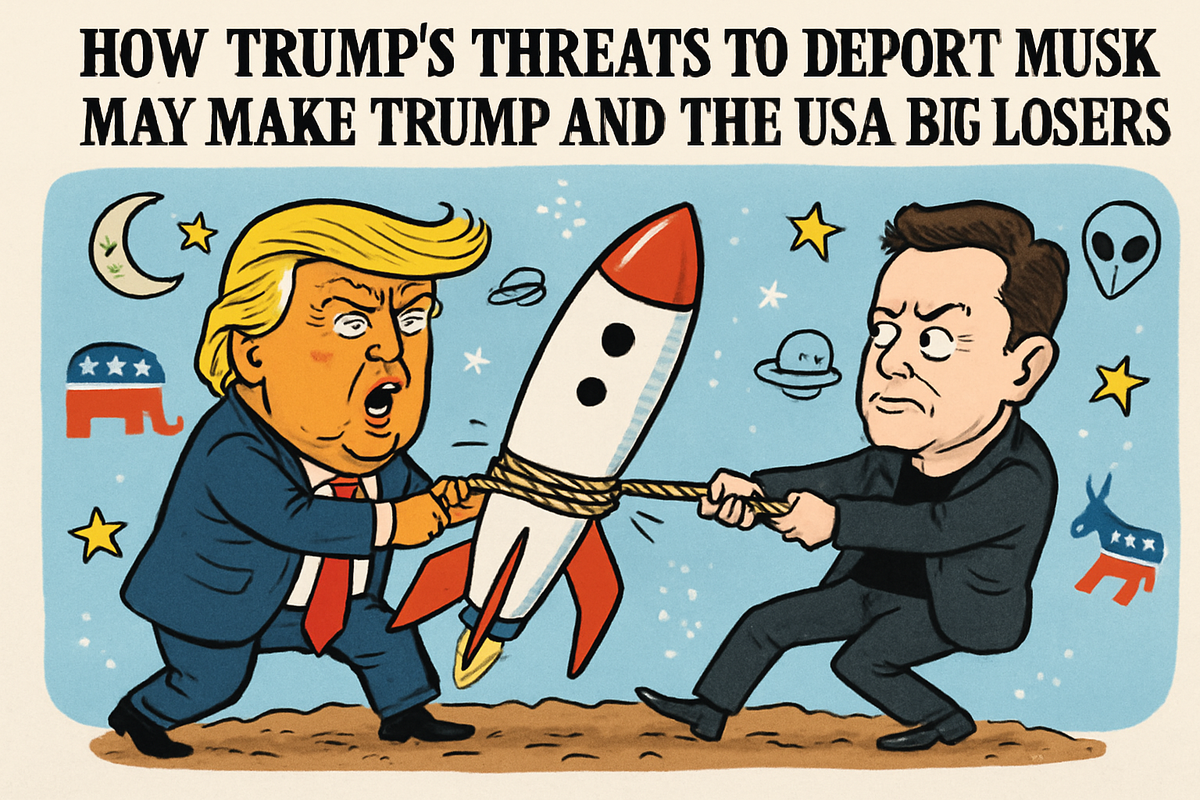
The feud that could hand America's greatest technological advantage to China
In what may go down as one of the most self-destructive political conflicts in American history, President Donald Trump's escalating threats to deport
The Irony of Reagan's Legacy
Remember when Ronald Reagan stood at the Brandenburg Gate and declared, "Mr. Gorbachev, tear down this wall!" That moment crystallized America's position as the champion of openness against barriers that divided people. The Berlin Wall became the ultimate symbol of oppression and isolation.
Fast-forward to today, and we find America building walls while threatening to deport one of its greatest technological assets. The contrast is striking and deeply troubling. Reagan understood that America's strength came from attracting the world's best minds, not driving them away.
What's Really at Stake
The current Trump-Musk feud isn't just political theater—it's a potential national security catastrophe waiting to unfold. Here's what America could lose:
Space Dominance
SpaceX has fundamentally transformed American space capabilities. The company launches over 90% of U.S. satellites and has become the backbone of NASA's operations. Without SpaceX's Dragon spacecraft, America would once again depend on Russia for access to the International Space Station—a humiliating reversal that would echo for decades.
$22 Billion in Critical Contracts
SpaceX holds approximately $22 billion in federal contracts spanning NASA missions, Pentagon launches, and classified intelligence operations. These aren't just business deals—they're the infrastructure of American space power.
Technological Innovation Engine
Musk's companies employ hundreds of thousands of Americans and have spawned entire industries. Tesla revolutionized electric vehicles, SpaceX made space commercially viable, and his ventures continue pushing technological boundaries that keep America competitive.
China's Strategic Windfall
The most terrifying prospect isn't just losing Musk—it's where he might go. China has already invested billions in Tesla's Shanghai Gigafactory, gaining invaluable insights into advanced manufacturing and battery technology. The precedent is clear: China would enthusiastically welcome a Shanghai SpaceX.
Consider what China would gain:
- Reusable rocket technology that took SpaceX decades to perfect
- Satellite deployment expertise critical for communications and military applications
- Manufacturing processes for space-grade components
- Orbital mechanics knowledge that could accelerate China's space ambitions by decades
Once this technology transfer occurs, it's irreversible. China could then export these capabilities globally, further undermining American strategic advantages.
The Silicon Valley Network Effect
Musk isn't operating in isolation. His connections throughout Silicon Valley run deep, particularly through the "PayPal Mafia"—former PayPal colleagues who now control critical technologies. Peter Thiel founded Palantir, the data analytics company that powers much of America's surveillance and intelligence operations. These interconnected relationships mean that alienating Musk could have cascading effects across multiple critical technology sectors.
Economic Self-Sabotage
Beyond technology, the economic implications are staggering. Musk's companies represent hundreds of billions in market value and support vast supply chains of American businesses. His ventures have:
- Created hundreds of thousands of high-paying American jobs
- Attracted top global talent to U.S. operations
- Driven innovation in multiple sectors simultaneously
- Generated billions in tax revenue
Threatening to deport someone who has contributed this much to American economic strength represents a stunning act of self-sabotage.
The Historical Pattern
America's greatest strength has always been its ability to attract and retain global talent. From Einstein fleeing Nazi Germany to today's tech entrepreneurs, America won by being the destination of choice for brilliant minds seeking opportunity and freedom.
Countries that drive away their most productive citizens inevitably decline. The Soviet Union's treatment of dissidents and intellectuals contributed to its eventual collapse. Today, we risk making the same mistake—not through ideology, but through personal pique and political revenge.
What's Really Driving This?
The feud ostensibly centers on Trump's spending bill and Musk's criticism of government fiscal policy. But the personal nature of Trump's attacks—calling Musk "CRAZY" and suggesting he should "head back home to South Africa"—reveals this is about wounded ego, not policy differences.
This is perhaps the most dangerous aspect: major national security decisions being driven by personal grievances rather than strategic thinking.
The Constitutional Question
Trump's threats to deport a naturalized citizen like Musk raise serious constitutional concerns. Such action would require proving citizenship was obtained through fraud—a virtually impossible case given Musk's documented legal immigration path. The threat itself, however, sends a chilling message to other immigrant entrepreneurs: your contributions don't guarantee your security.
A Wake-Up Call for America
This crisis should force Americans to confront an uncomfortable truth: the country's strength has always depended on remaining open to the world's best minds. Building walls—literal or metaphorical—and threatening to expel productive citizens represents a fundamental departure from what made America great.
The irony is profound. In attempting to "Make America Great Again," these threats could hand America's greatest technological advantages to its primary strategic competitor.
The Path Forward
America needs leaders who understand that strength comes from attraction, not coercion. The country should be competing to keep brilliant minds like Musk, not finding reasons to drive them away.
The solution isn't just avoiding deportation threats—it's recommitting to the values that made America the world's destination for talent: opportunity, rule of law, and the promise that contribution matters more than origin.
The Bottom Line
If Trump follows through on threats to cancel Musk's contracts or pursue deportation, he risks engineering one of the greatest strategic blunders in American history. China would gain decades of technological advancement overnight, while America would lose its space advantage, weaken its economy, and signal to the world that even its most productive citizens aren't safe from political retaliation.
In the end, the biggest losers wouldn't be Trump or Musk—they'd be the American people, watching their country voluntarily surrender its technological edge to a strategic rival over a personal feud.
The question isn't whether America can afford to lose Elon Musk. It's whether America can afford the precedent of driving away its most valuable contributors over political disagreements. History suggests the answer should terrify us all.
Reagan understood walls divide and weaken. Today's leaders would do well to remember that lesson before it's too late.