
How Restrictive Immigration Policies Could Have Reshaped America: A Historical Analysis
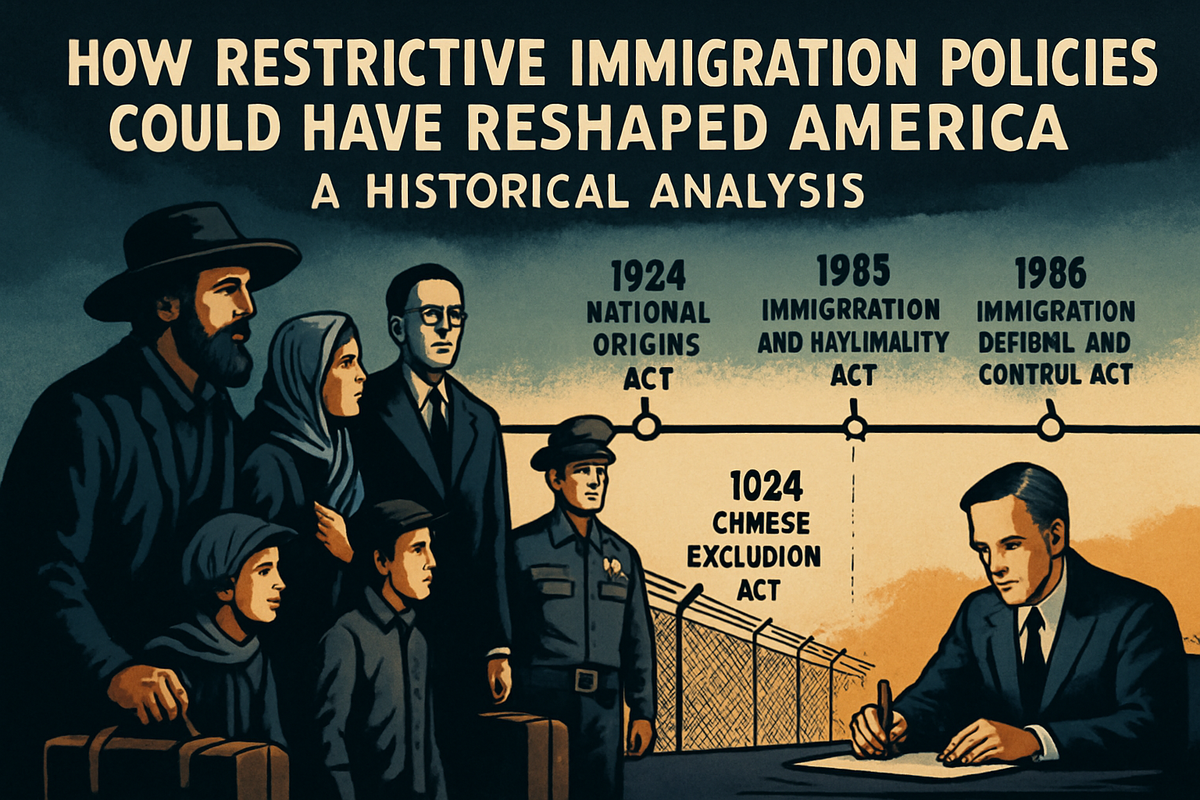
A thought experiment examining how America's development might have differed under consistently restrictive immigration policies
America's story is fundamentally an immigration story. From the Irish fleeing famine to the Germans seeking opportunity, from Chinese railroad workers to Eastern European refugees, each wave of newcomers has shaped our national character, economy, and culture. But what if America had pursued restrictive immigration policies during each of these pivotal moments? How might our country look different today?
The Irish Famine Era (1840s-1850s): A Nation That Stayed Small
Imagine if America had closed its doors during the Irish Potato Famine. Over one million Irish immigrants would never have arrived, fundamentally altering the trajectory of American cities and labor.
What We'd Have Lost: The Irish provided crucial labor for America's growing cities and infrastructure projects. Without them, the construction of canals, railroads, and urban buildings would have proceeded much more slowly. Cities like Boston, New York, and Chicago would have developed differently, likely remaining smaller and less economically dynamic.
Political Implications: The Irish became a powerful political force, particularly in the Democratic Party. Without their influence, American politics would have evolved along different lines, potentially with less emphasis on urban concerns and working-class issues.
Cultural Impact: No St. Patrick's Day parades, no Irish-American cultural institutions, and a very different American Catholic Church. The vibrant Irish-American communities that enriched American culture simply wouldn't exist.
The German Immigration Wave (1840s-1880s): Missing the Engine of Innovation
German immigrants brought technical skills, educational traditions, and entrepreneurial spirit that helped drive America's industrial revolution.
Economic Consequences: German immigrants founded major businesses (Anheuser-Busch, Steinway pianos, Levi Strauss), established technical schools, and brought advanced manufacturing techniques. Without them, America's industrial development would have lagged significantly behind European competitors.
Educational Impact: Germans introduced kindergarten, physical education, and advanced technical training to American schools. Our educational system would be markedly different and possibly less effective without these innovations.
Innovation Deficit: Many German immigrants were skilled craftsmen, engineers, and scientists. America would have missed out on countless innovations and the entrepreneurial energy that helped fuel westward expansion.
Chinese Exclusion Prevented (1850s-1880s): The Railroad That Wasn't Built
Chinese immigrants were essential to completing the Transcontinental Railroad and developing the American West.
Infrastructure Crisis: Without Chinese workers, the western portion of the Transcontinental Railroad might never have been completed, or would have taken decades longer. This would have dramatically slowed California's development and America's emergence as a continental power.
Western Development: The economic development of California, mining operations, and agricultural expansion in the West all depended heavily on Chinese labor and entrepreneurship. The American West would have remained a frontier much longer.
Economic Isolation: Chinese immigrants also served as crucial links to Asian markets. Without them, America's Pacific trade relationships would have developed much more slowly, potentially limiting our role as a Pacific power.
The Great Wave Stopped (1880s-1920s): A Very Different America
This was the largest immigration wave in American history, bringing millions from Southern and Eastern Europe.
Industrial Revolution Stalled: These immigrants provided the labor force for America's steel mills, factories, and mines. Without them, the rapid industrialization that made America a global power would have been impossible. We might have remained primarily an agricultural nation well into the 20th century.
Urban Development: Major cities like New York, Chicago, and Detroit were built by immigrant labor and populated by immigrant communities. These cities would be shadows of what they became, limiting America's urban development and economic concentration.
Innovation and Entrepreneurship: Countless businesses, from small neighborhood shops to major corporations, were founded by these immigrants or their children. The entrepreneurial energy they brought was crucial to American economic dynamism.
Scientific and Cultural Contributions: Many of America's greatest scientists, artists, and intellectuals came from these immigrant communities. Our universities, cultural institutions, and research capabilities would be dramatically diminished.
Modern Implications: The Cumulative Effect
By the mid-20th century, an America that had consistently restricted immigration would be:
Economically Smaller: With a much smaller population and workforce, America's economy would be a fraction of its actual size. We might never have become a global economic superpower.
Less Innovative: The diversity of perspectives, skills, and knowledge that immigrants brought was crucial to American innovation. Our technological leadership would be questionable.
Geopolitically Weaker: A smaller, less dynamic America would struggle to play the global role it has historically assumed. We might not have been able to decisively influence either World War or lead the Western alliance during the Cold War.
Culturally Homogeneous: American culture would be far less rich and diverse. The foods we eat, music we listen to, and traditions we celebrate would be dramatically different and more limited.
The Population Reality
Perhaps most strikingly, America's population would be dramatically smaller. Instead of over 330 million people today, we might have fewer than 100 million. This would affect everything from our economic power to our political influence to our ability to defend ourselves.
Lessons for Today
This thought experiment reveals how immigration has been fundamental to American success. The economic dynamism, cultural richness, and global influence we take for granted were not inevitable – they were built by successive waves of immigrants who chose to make America their home.
The pattern throughout American history has been initial resistance to new immigrant groups, followed by their integration and contribution to national success. Each generation of immigrants faced similar criticisms about their ability to assimilate, their economic impact, and their cultural differences. Yet each wave ultimately strengthened rather than weakened the nation.
Conclusion
Consistently restrictive immigration policies throughout American history would have created a fundamentally different country – one that was smaller, less prosperous, less innovative, and less influential on the world stage. The America we know today was built not despite immigration, but because of it.
This historical analysis doesn't resolve today's immigration debates, but it does provide important context. The immigrants who seemed threatening or burdensome to previous generations often became the foundation of American strength in the next. As we face contemporary immigration challenges, this history reminds us that America's openness to newcomers has been one of our greatest strategic advantages.
The question isn't whether immigration changes America – it always has. The question is whether those changes make us stronger or weaker. History suggests that when America has embraced immigrants, both the newcomers and the nation have prospered.