
How Building Walls and Deporting People Doesn’t Prevent Crime or Terrorism
Introduction
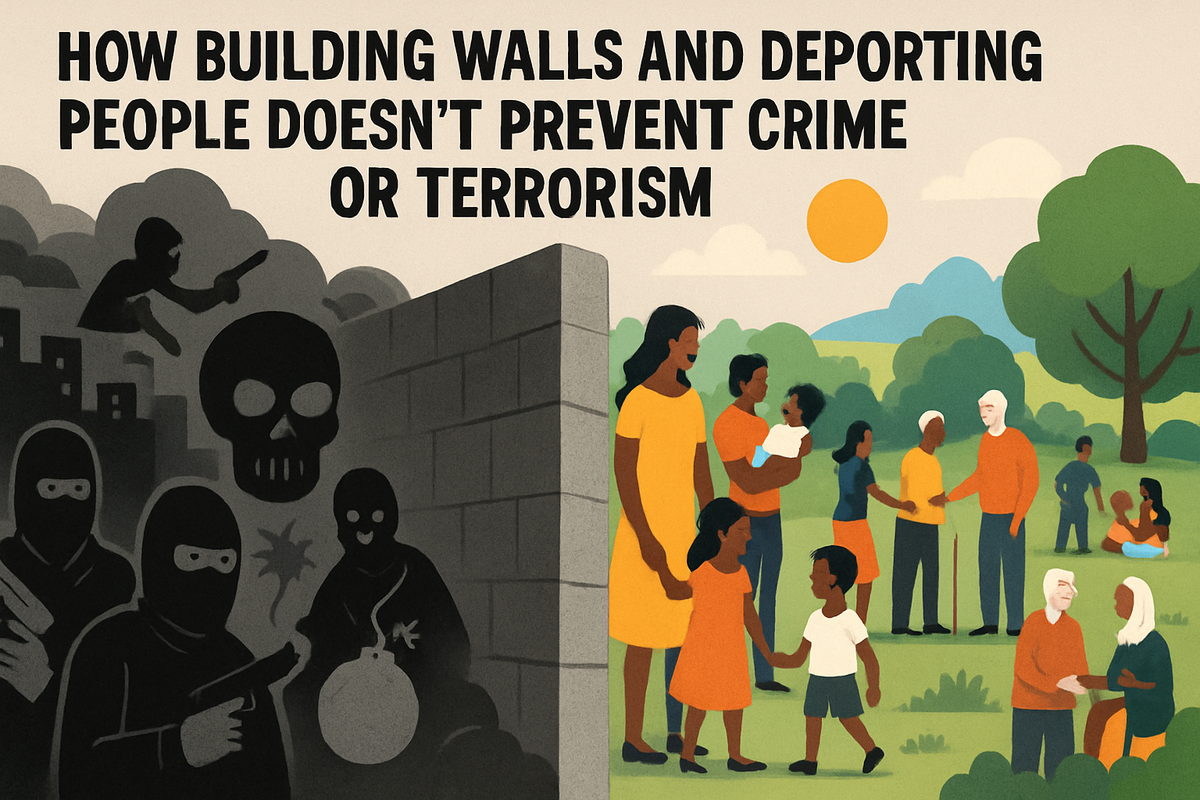
In recent years, the idea of building physical barriers and increasing deportations has gained traction as a way to combat crime and terrorism. However, evidence and expert analysis consistently show that these measures are not effective solutions. Instead, they often create new problems while failing to address the root causes of violence and insecurity.
The Myth of Walls as Crime Stoppers
1.Walls Do Not Address Root Causes
- Crime and terrorism are driven by complex social, economic, and political factors—not merely by the movement of people across borders.
- Barriers do nothing to address poverty, lack of opportunity, or political grievances that fuel criminal activity and extremist violence.
2.Criminals and Terrorists Adapt
- Physical walls are easily bypassed: Smugglers use tunnels, drones, boats, and forged documents to evade barriers.
- Most terrorists responsible for attacks in the U.S. and Europe have been citizens or legal residents—not border crossers.
3.Walls Harm Communities
- Dividing communities can disrupt local economies, harm families, and create humanitarian crises without improving security.
- Barriers often push migrants and refugees into more dangerous routes, increasing deaths and empowering criminal smuggling networks.
Deportation: An Ineffective and Counterproductive Tool
1.Deportation Does Not Deter Crime
- Studies show no clear link between higher deportation rates and lower crime rates.
- Many deportees are nonviolent offenders or people with deep community ties; removing them can break up families and destabilize neighborhoods.
2.Terrorism Is Rarely Imported
- Most acts of terrorism are committed by citizens or long-term residents, not recent immigrants.
- Focusing on deportation diverts resources from intelligence, community engagement, and other proven counter-terrorism strategies.
3.Deportation Can Fuel Instability
- Mass deportations can destabilize countries of origin, creating conditions that foster crime and extremism—sometimes with spillover effects.
What Actually Works?
1.Community Policing and Integration
- Building trust between law enforcement and immigrant communities improves reporting of crime and cooperation in investigations.
- Integration programs help newcomers become productive members of society, reducing marginalization and resentment.
2.Intelligence and International Cooperation
- Effective counter-terrorism relies on intelligence sharing, not physical barriers.
- International partnerships and information exchange are crucial to tracking and preventing transnational threats.
3.Addressing Root Causes
- Investing in education, economic opportunity, and conflict resolution addresses the underlying drivers of crime and terrorism.
- Prevention is more effective and humane than exclusion or punishment.
Conclusion
Walls and deportations are simplistic responses to complex challenges. Evidence shows they do not prevent crime or terrorism and can even make matters worse. Real security comes from addressing root causes, fostering inclusion, and relying on strategies that are proven to work.