
Don't Appease a Tyrant: Trump's $1 Billion "Board of Peace" and the Return of Protection Racket Diplomacy
I used to be the kind of person who believed things would work out. Happy-go-lucky, my best friend called me during the COVID shutdown. We were doing these weekly word origin exercises to stay connected, and when he researched "happy-go-lucky," he said it was literally the definition of my personality. That was then.
Then I watched family members refuse vaccines and call Anthony Fauci a criminal for updating guidance as the science evolved. I spent over $10,000 and drove 15,000 miles helping two friends who were homeless, only to have one die of an overdose and the other end up in jail for burglary. My car broke down. I got married. Haven't communicated with my husband since April 2023. I lost that happy-go-lucky somewhere in there, and I can't get it back even though I want to.
I'm telling you this because I need you to understand: I don't *want* to be writing this article. I don't *want* to be the person seeing patterns of authoritarian consolidation and international protection rackets. I'd much rather believe that democratic institutions will hold, that international law matters, that the post-WWII order isn't being dismantled by a real estate developer who learned politics from a mob lawyer.
But I can't pretend anymore. And neither should you.
This week in Davos, Switzerland, world leaders are being pressured to sign a charter for Trump's "Board of Peace." The price of permanent membership? **One billion dollars.** The structure? Trump serves as chairman with veto power over every decision, the authority to remove any member, the right to dissolve the organization whenever he wants, and he stays in charge until he voluntarily resigns or becomes "incapacitated" - with no succession process specified.
France declined to join. Trump immediately threatened 200% tariffs on French wine and champagne. The UK, Sweden, Netherlands, Germany, and Canada are all reportedly refusing to sign. Trump has invited Vladimir Putin, Viktor Orbán, and authoritarian leaders from Belarus to Vietnam while threatening democracies into compliance with economic warfare.
If this sounds familiar, it should.
## The Lesson We Were Supposed to Learn
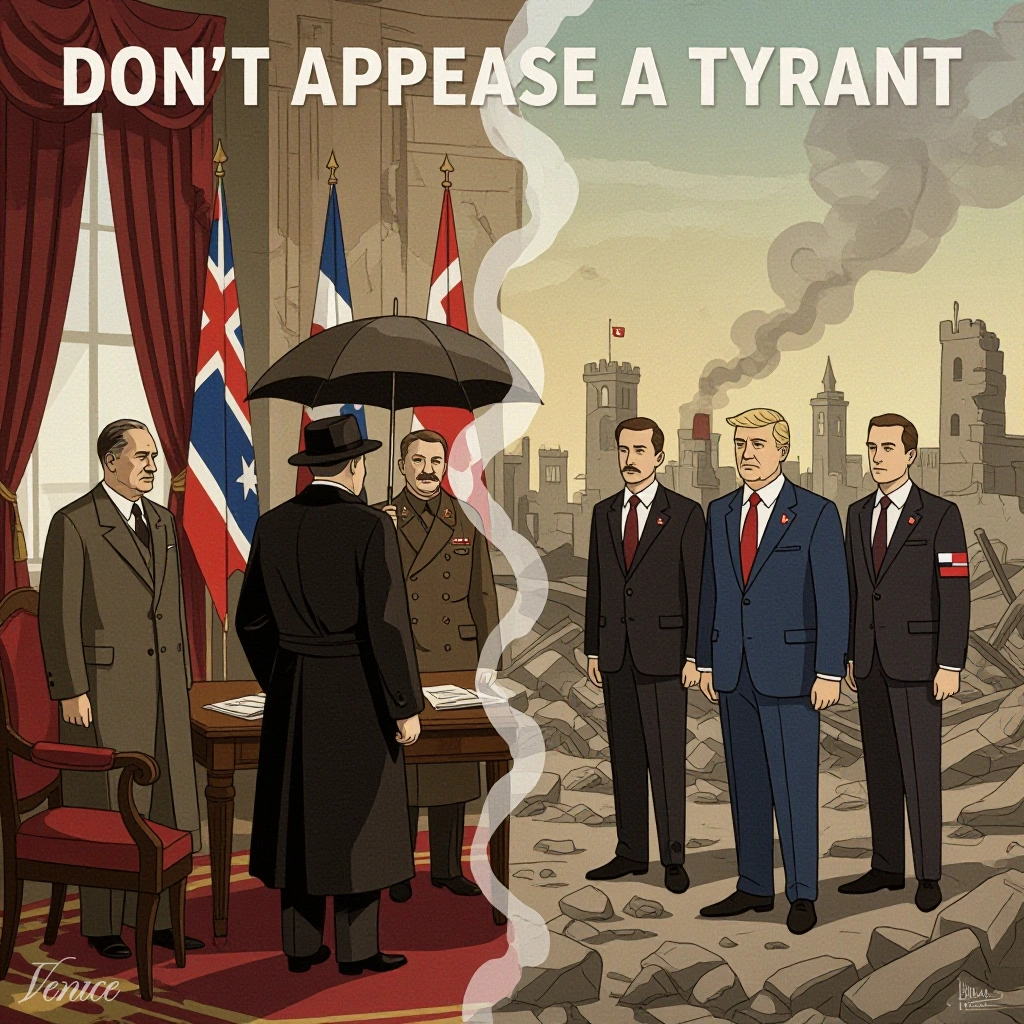
Britain, France, and Russia tried to appease Hitler. They negotiated. They made concessions. They believed that giving him what he wanted would satisfy his ambitions and prevent war. We know how that ended. The lesson was supposed to be universal: you don't negotiate with authoritarians who use economic coercion and military force to reshape the international order around their personal power. You certainly don't pay them tribute and give them institutional veto authority.
Yet here we are. Democratic nations being asked to pay $1 billion for the privilege of having their votes vetoed by a chairman who can dissolve the organization on a whim. And if they refuse? Economic punishment until they comply.
This isn't diplomacy. This is a protection racket with a UN Charter veneer.
## The "Board of Peace": Questions That Expose the Structure
Let me walk you through what we actually know about this organization, because the more you look at the details, the worse it gets.
**What is the Board of Peace?**
It was marketed as an organization to oversee Gaza reconstruction. That's what they told the world. But the charter itself - the actual founding document sent to approximately 60 countries - makes no mention of Gaza. Not once. Instead, it describes itself as "an international organization that seeks to promote stability, restore dependable and lawful governance, and secure enduring peace in areas affected or threatened by conflict."
That's global scope. That's positioning itself as an alternative to the United Nations Security Council. The UN Security Council mandate that endorsed this board in November 2025 was limited to Gaza and only runs until the end of 2027. The charter Trump is circulating? No such limits.
**Who controls it?**
Donald Trump serves as inaugural chairman. He also "separately serves as inaugural representative of the United States." He has "exclusive authority to create, modify, or dissolve subsidiary entities as necessary or appropriate." He picks the members of the Executive Board for two-year terms "subject to removal by the Chairman." He sets the agenda for all meetings. He is "the final authority regarding the meaning, interpretation, and application of this Charter."
The charter specifies that while decisions require "a majority of Member States present and voting," they are all "subject to the approval of the chairman, who may also cast a vote in his capacity as chairman in the event of a tie."
Read that again. Every decision needs majority approval AND Trump's approval. He has a veto. The voting is theater.
And how is the chairman replaced? Only "in case of voluntary resignation or as a result of incapacity." No election. No term limits. No democratic process. Just Trump deciding if and when he's done.
Oh, and when does the Board of Peace dissolve? "At such time as the Chairman considers necessary or appropriate, or at the end of every odd-numbered calendar year, unless renewed by the Chairman no later than November 21 of such odd-numbered calendar year."
Trump decides when it ends. Trump decides if he stays. Trump renews it or kills it. That's not an oversight in the charter. That's the charter working as designed.
**How much does it cost?**
One billion dollars in cash for permanent membership. If you don't pay, you get a three-year term "subject to renewal by the Chairman." Which means if Trump doesn't like you, or if you don't vote the way he wants, your membership expires and you're gone.
This isn't a contribution based on GDP or economic capacity. This is a flat fee. Pay a billion, get permanent status. Don't pay, serve at Trump's pleasure.
**Where does the money go?**
Here's where it gets interesting. A U.S. official told CNN that "virtually every dollar" raised would go to rebuilding Gaza, with "no exorbitant salaries and massive administrative bloat." That sounds reassuring until you read the actual charter.
The charter states that funding will be "through voluntary funding from Member States, other States, organizations, or other sources." That's it. No breakdown. No accountability structure. No specification of where the billion-dollar membership fees are held or how they're distributed.
When reporters asked where the funds would be held, the answer was: unclear.
**How much goes to Palestinians?**
No breakdown has been provided. The charter describes governance arrangements where day-to-day administration will be handled by a Palestinian "technocratic committee" - not elected representatives, technocrats. This committee will be supervised by the Board of Peace and by two executive boards. There are no concrete benchmarks or timeframes for transition to actual Palestinian self-governance.
UN experts issued a statement: "The 'temporary transitional government' is not representative of Palestinians and even excludes the Palestinian Authority, further violating self-determination and lacking legitimacy. There are no concrete benchmarks or timeframes for a transition to representative governance, which belongs to the Palestinians only, without foreign interference. Oversight by a 'Board of Peace' chaired by the US President is not under United Nations authority or transparent multilateral control, while the US is a deeply partisan supporter of Israel and not an 'honest broker.' This proposal is regrettably reminiscent of colonial practices and must be rejected."
Israeli Prime Minister Benjamin Netanyahu objected that the executive committee "was not coordinated with Israel and runs contrary to its policy," specifically opposing the inclusion of Turkey and Qatar. So even Israel - the supposed beneficiary of this arrangement - is raising objections to how it's structured.
**How does it conflict with the UN Charter?**
UN Special Rapporteur Francesca Albanese condemned the UN Security Council resolution that endorsed the Board of Peace, saying it violates Palestine's right to self-determination under Article 1(2) of the UN Charter. She stated that "rather than charting a pathway toward ending the occupation and ensuring Palestinian protection, the resolution risks entrenching external control over Gaza's governance, borders, security, and reconstruction."
She specifically called out the structure: "A military force answering to a so-called 'Board of Peace' chaired by the President of the United States, an active party to this conflict that has continually provided military, economic and diplomatic support to" Israel.
One diplomat, speaking to Reuters, was more blunt: "It's a 'Trump United Nations' that ignores the fundamentals of the UN charter."
The UN mandate is limited to Gaza until 2027. The charter claims global authority. The UN operates through collective decision-making with great power vetoes distributed among five permanent members. This Board gives Trump personal veto power. The UN has institutional continuity with established succession. This Board dissolves when Trump wants it to and has no succession plan.
That's not reforming the UN. That's replacing it with something Trump personally controls.
## The Pattern: This Isn't Isolated
If the Board of Peace existed in isolation, maybe you could argue it's just an experimental approach to Gaza reconstruction. But it doesn't exist in isolation. This is part of a systematic pattern over the past year of applying the same structure to every international interaction: identify what someone values, threaten to destroy it, extract maximum value while maintaining personal control.
**Venezuela - January 3, 2026**
Trump launched "Operation Absolute Resolve," a special forces raid that killed approximately 75 Cuban and Venezuelan guards and extracted President Nicolás Maduro and his wife from their compound in Caracas. They were flown to New York to face narcoterrorism charges.
At his press conference announcing the operation, Trump made the motivation explicit: Venezuela's oil revenue would go "to the United States of America in the form of reimbursement for the damages caused us by that country." He later elaborated, citing the nationalization of Venezuela's oil industry in 1976 and 2007, claiming Venezuela had "stolen oil from US companies."
That's not international law. That's not counternarcotics operations. That's seizing another nation's president by military force and claiming their natural resources as "reimbursement." It's extraction through violence.
The operation was rehearsed for months using a replica of the building. The CIA tracked Maduro's movements. A naval armada positioned off the coast. And when Trump called Maduro a week before to demand surrender, Maduro "came close" but refused. So Trump took him anyway.
Venezuela now has an interim president, Delcy Rodríguez, whom the Trump administration is pressuring to meet U.S. demands: reforms to Venezuela's oil industry, removal of advisors from China, Cuba, Iran and Russia, and release of political prisoners. The U.S. military presence in Venezuela continues, with Secretary of State Marco Rubio outlining a "three-phase plan" to pressure the remaining regime.
**Ukraine - April 30, 2025**
The U.S.-Ukraine minerals deal was signed after months of contentious negotiations. Trump initially demanded $500 billion in profits from Ukraine's rare earth minerals and other resources as compensation for military aid already provided. When President Zelensky rejected this, Trump publicly called him "a dictator."
The final agreement gives the United States preferential rights to mineral extraction in Ukraine, including rare earths, oil, natural gas, gold, copper, titanium, lithium, and uranium - 55 minerals total, with more able to be added. Ukraine retains ownership of subsoil and final say on what is mined, but the economic reality is clear: future American military assistance counts as capital contributions to a joint reconstruction investment fund. Ukraine commits to contribute 50% of future proceeds from state-owned resources.
The deal establishes that the United States will have an equal say in managing the fund through the International Development Finance Corporation. No profits will be taken from the fund for the first 10 years, but after that, the revenue-sharing begins.
Treasury Secretary Scott Bessent said the deal shows Russia that the Trump administration is "committed to a peace process centered on a free, sovereign, and prosperous Ukraine over the long term." But the deal includes no explicit U.S. security guarantees. Trump has said: "I'm not going to make security guarantees beyond very much. We're going to have Europe do that."
So: America gets mineral rights. Europe provides security guarantees. Ukraine gets reconstruction investment tied to resource extraction. And if you're wondering whether this is commercially viable given that most deposits are either under Russian control or in range of Russian artillery, most of Ukraine's geological surveys are 30-60 years old from the Soviet era, and mining operations require massive ⁹ well, those are excellent questions with no clear answers.
**The White House - October 2025**
Trump demolished the entire East Wing of the White House, including the Presidential Emergency Operations Center bunker built by Franklin D. Roosevelt during World War II. The stated reason was to make way for a $400 million ballroom that Trump says will be funded by private donors.
The bunker beneath the East Wing - which has been used during the 9/11 attacks, during protests in Trump's first term, and during other national emergencies - was completely torn out. Sources told CNN there is "high degree of confidence" that all previous subterranean structures are now gone.
It's being rebuilt, officials say, with "new technology to counter evolving threats." The White House argued in a court filing that halting construction would "endanger national security and therefore impair the public interest."
When asked why the Trump administration demolished the East Wing without seeking approval from the National Capital Planning Commission, White House Director of Management and Administration Joshua Fisher cited the sensitive nature of the project: "There are some things regarding this project that are, frankly, of top-secret nature that we are currently working on."
The ballroom cost has ballooned from Trump's initial $200 million estimate to at least $400 million. That doesn't include the underground reconstruction, which is being paid for by U.S. taxpayers.
**The "Arc de Trump" - Announced October 2025**
Trump unveiled plans for a triumphal arch to be built between the Lincoln Memorial and Arlington National Cemetery to commemorate America's 250th anniversary. He displayed models in three sizes at a White House fundraiser dinner in October, telling donors: "It's going to be really beautiful. I think it's going to be fantastic. There's a rendering of what it will look like. You have three sizes. Whichever one would look good. I happen to think the large one."
The design is modeled on Paris's Arc de Triomphe, featuring columns, eagles, wreaths, and a gilded winged figure. When reporters asked Trump who the arch was for, he pointed at himself and said: "Me."
Construction is set to begin "within the next two months" according to Trump's December 31 statement to Politico. Some of the leftover funds from the ballroom project will be used to finance it. Trump said the project is "fully financed" and will be completed in time for the 250th anniversary.
Federal agencies have not confirmed formal approvals or permits. The monument will be built on federal land at Memorial Circle, a prominent traffic circle on Memorial Drive between the Arlington Memorial Bridge and Arlington National Cemetery.
**The Kennedy Center - December 18, 2025**
Trump fired multiple members of the Kennedy Center Board of Trustees in February 2025 and became its chairman. In December, his hand-picked board voted "unanimously" to rename the John F. Kennedy Center for the Performing Arts as "The Donald J. Trump and The John F. Kennedy Memorial Center for the Performing Arts."
The vote happened during a board meeting where Trump called in. Democratic Rep. Joyce Beatty, an ex-officio member of the board, said she was muted during the meeting when she tried to voice opposition and "was not allowed to vote because I was muted."
Federal law (Title 20 of the U.S. Code, section 76i) designates the building "the John F. Kennedy Center for the Performing Arts." Legal experts say congressional approval is required to change the name.
The signage was changed the next day anyway. Workers installed new lettering on the building's facade within 24 hours of the vote.
The Kennedy Center has since faced mass cancellations from artists. Chuck Redd canceled his annual Christmas Eve jazz performance. The Cookers backed out of New Year's Eve. Doug Varone Dance Company, Martha Graham Dance Company, composer Stephen Schwartz, and banjo player Béla Fleck have all canceled or withdrawn from scheduled performances. The Kennedy Center is threatening to sue Redd for $1 million for his cancellation.
Maria Shriver, President Kennedy's niece, called the renaming "beyond comprehension," noting that Kennedy "was a man who was interested in the arts, interested in culture, interested in education, language, history. He brought the arts into the White House, and he and my Aunt Jackie amplified the arts, celebrated the arts, stood up for the arts and artists. It is beyond comprehension that this sitting president has sought to rename this great memorial dedicated to President Kennedy."
Trump had been joking about calling it the "Trump Kennedy Center" since early in his term. In August 2025, he posted on Truth Social: "GREAT Nominees for the TRUMP/KENNEDY CENTER, whoops, I mean, KENNEDY CENTER."
The "joke" became official policy four months later
## Where Did This Come From?
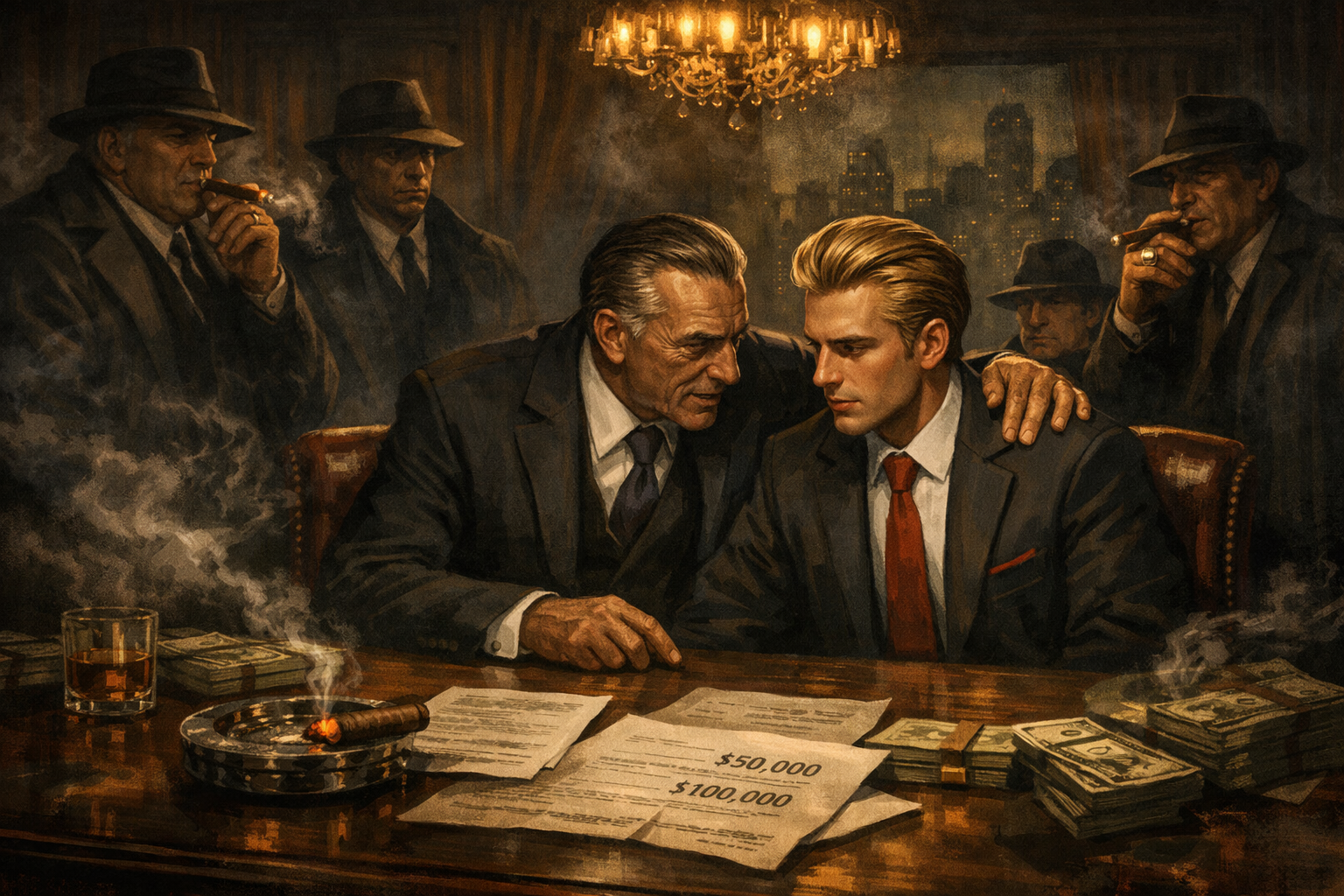
Look at that image. Really look at it. The mentor and the student. The contracts with dollar amounts on the table. The cash in stacks. The muscle standing ready in the shadows. The intimate moment of instruction while power looms behind them. The chandelier overhead, the whiskey, the smoke, the understanding that when business is conducted in rooms like this, the only thing that matters is leverage.
That's Roy Cohn teaching Donald Trump how power actually works.
Roy Cohn was Trump's lawyer and mentor from 1973 until Cohn's death in 1986. Cohn had been Senator Joseph McCarthy's chief counsel during the Red Scare hearings. He'd defended mafia bosses. He'd made his career on three principles: never admit weakness, always attack, and loyalty is the only currency that matters.
Trump learned well. The playbook Cohn taught him in New York real estate is now being applied to the international order:
**Never settle, always attack.** When France declines Board of Peace membership, don't negotiate - threaten 200% tariffs until compliance. When Zelensky won't give you $500 billion, call him a dictator publicly. When artists cancel Kennedy Center performances, sue them for $1 million.
**Identify what someone values, threaten to destroy it, extract maximum value.** European nations value their trade relationships with the U.S.? Threaten tariffs. Ukraine values military aid? Demand mineral rights. Kennedy Center performers value their reputations? Accuse them of "intolerance" through the president.
**Loyalty is the only currency.** The Board of Peace isn't structured around shared principles or democratic processes. It's structured around personal loyalty to Trump. Pay your billion. Accept his veto. Serve at his pleasure. That's the deal.
**Rules apply to other people.** Federal law says the Kennedy Center can only be renamed by Congress? Change it anyway. UN mandate limits the Board of Peace to Gaza until 2027? Write a charter claiming global authority. International law prohibits seizing other nations' presidents and claiming their resources? Do it anyway and call it "reimbursement."
**No institutional oversight - just the boss's decision.** The Board of Peace gives Trump sole authority to interpret the charter, remove members, dissolve the organization, and veto any decision. That's not multilateral cooperation. That's "the boss said so."
And succession? In this model, it goes to family. Because family loyalty is the most reliable. Institutions can turn on you. Laws can be weaponized against you. But family - especially family that's been in the room for all of it, that's implicated in the same deals - family stays loyal because their interests are aligned.
Jared Kushner is on the Executive Board. He was the architect of the Abraham Accords. He knows the Middle East players. He has relationships with Saudi Arabia, UAE, Qatar. He understands the transactional model because he learned it the same way Trump did - by watching, by being in the room, by seeing how deals actually get made when you strip away the institutional veneer.
When Trump becomes "incapacitated" or decides to step down from a Board of Peace with no specified succession process, who's positioned to inherit it? The son-in-law who's been there from the start. The crown prince who learned the business.
The Board of Peace isn't structured like the UN with institutional continuity, democratic processes, and transparent multilateral control. It's structured like what you see in that smoky room: the boss at the head of the table, the muscle in the background, the contracts with dollar amounts, the cash changing hands, and the understanding that when the boss decides you're out, you're out.
Roy Cohn died in 1986. But his playbook didn't die with him. It moved from New York real estate to Atlantic City casinos to reality television to the White House to the international stage. And now it's being institutionalized in a charter that asks sovereign nations to pay tribute for the privilege of being overruled.
This is what Trump learned. This is where the structure comes from. And this is what happens when you let that structure operate at the scale of international relations instead of just real estate deals.
## The Stakes: Why This Matters Now
I keep thinking about that appeasement image. The diplomats in their formal attire maintaining protocol while cities burn in the background. The umbrella that immediately evokes Chamberlain. The understanding that we've been here before and we know how it ends.
We're not watching history repeat. We're watching it rhyme.
This week in Davos, democratic leaders face a choice. They can sign Trump's charter, pay the billion dollars, accept his veto power, legitimize this structure, and hope it somehow leads to actual peace instead of consolidated authoritarian control. Or they can hold the line, refuse to participate, face the economic warfare that Trump has already begun deploying, and try to maintain the post-WWII international order that, for all its flaws, at least distributed power among multiple actors instead of concentrating it in one man with no institutional checks.
France, the UK, Sweden, Netherlands, Germany, Canada - they're reportedly refusing. Good. But refusing isn't enough. Because while democracies debate and consult and worry about process, Trump is inviting Putin, Orbán, and every authoritarian who understands that this isn't about peace in Gaza. This is about replacing the UN with a structure where the chairman has a veto, serves for life, and dissolves the organization when he's ready to hand it to his family.
The lesson of the 1930s wasn't just "don't appease tyrants." It was "stop them before they consolidate enough power that stopping them requires total war."
We're watching the consolidation happen in real time. Venezuela's president extracted and its oil claimed as "reimbursement." Ukraine's minerals demanded as the price of defense. Democratic nations threatened with economic warfare for refusing tribute. A "Board of Peace" structured to give Trump permanent, unaccountable, vetoable control over conflict resolution worldwide. His name added to memorials, monuments, institutions. His family embedded in the executive positions. His playbook scaled from New York real estate to sovereign nations.
I've lost my happy-go-lucky. I can't pretend things will just work out anymore. I've watched too much, learned too much, tracked too many patterns. This isn't paranoia. This isn't partisan anxiety. This is just pattern recognition and reading the actual documents.
The Board of Peace charter is public. The Venezuela operation happened. The Ukraine minerals deal was signed. The Kennedy Center was renamed. The Arc de Trump is being built. These aren't conspiracy theories. These are just facts that form a pattern when you look at them together.
And the pattern is clear: We're watching the post-WWII international order - with all its flaws and failures and frustrations - being replaced by a protection racket where you pay tribute to the chairman, accept his veto, serve at his pleasure, and hope his family treats you well when they inherit it.
## To Our Friends in Europe, Asia, South America, Oceania
You know what appeasement looks like. You've studied it. You've built your entire post-war order around the promise of "never again." You know where it leads.
The man threatening your economies for refusing his "Board of Peace" is the same man who:
- Launched military strikes to seize another nation's president and claimed their oil as "reimbursement"
- Demanded $500 billion in mineral rights as the price of defending an ally from invasion
- Demolished a presidential bunker built during World War II to make room for a $400 million ballroom
- Built himself a triumphal arch and, when asked who it was for, pointed at himself
- Put his name on a memorial to a murdered president despite federal law requiring congressional approval
- Structured an international organization to give himself veto power, permanent chairmanship, authority to remove members, and the right to dissolve it whenever he wants
This isn't diplomacy. It's not multilateral cooperation. It's not a "bold new approach to resolving global conflict."
It's a protection racket with fighter jets and UN resolution veneer.
The question isn't whether Trump has the power to do this. He clearly does. The question is whether democracies will legitimize it by paying tribute and accepting his veto, or whether they'll hold the line before it requires another generation of soldiers to undo.
You've been here before. Please don't make the same mistake.
The charter makes no mention of Gaza. It claims global authority. It has no accountability structures. The chairman serves until voluntary resignation or incapacity with no succession process. Decisions require his approval. He dissolves it when he wants. The money goes... somewhere. "Virtually every dollar" to Gaza reconstruction, they say, but the charter doesn't specify and nobody knows where the billion-dollar membership fees are held.
And when you refuse? He threatens to destroy your wine industry, your export markets, your economic relationships until you comply.
That's not peace-building. That's coercion.
Don't appease a tyrant. We know how that ends. The burning cities aren't in the background anymore. They're in Gaza. They were in Venezuela. They're wherever the chairman decides he needs "reimbursement" or "reconstruction" or "peace" as defined by him, interpreted by him, enforced by him, and renewed or dissolved at his pleasure.
Hold the line. Please. Before it requires more than economic courage to stop him.
---
I miss being happy-go-lucky. I miss believing things would work out. I miss not seeing patterns of authoritarian consolidation in every international interaction. I miss not having to write articles explaining why paying a billion dollars to join an organization where Trump has veto power and can remove you at will is actually just appeasement with a price tag.
But I can't unknow what I know. And neither can you.
The Board of Peace isn't about peace. It's about power. Personal, unaccountable, hereditary power dressed up in diplomatic language and marketed as conflict resolution.
We've been here before. Let us not make the same mistake.
**— Terry**
*Three Strikes of Difference: Here to challenge, reflect, provoke*